First: A Word on Pace
Judaism rewards depth, not speed. The Jewish journey is the work of a lifetime; the first weeks should be calm and curious.
Summary. Judaism is a 3,500-year-old conversation, and a New Jew’s first instinct is often to try to drink the whole ocean at once. Usually, a more measured approach is best. Choose one prayer, one mitzvah, one chapter of Torah. Show up to shul, listen, and let the structure of Jewish life teach you on its own terms. Everything else—the books, the Hebrew, the Talmud, the holidays—will arrive in due course. The single most important practice is to keep showing up.
The advice most often given to ba’alei teshuva (returnees) and converts is some version of, “Don’t try to do everything at once.” Rabbi Moshe Feinstein, the dominant American halachic authority of the twentieth century, repeatedly counseled in his responsa (Igrot Moshe) that incremental, sincere observance is vastly preferable to a sprint that ends in burnout. The Talmud expresses this with the maxim ein hakadosh baruch hu ba bitrunia im briyotav—“the Holy One does not act unfairly toward His creatures” (Avodah Zarah 3a). God did not give the Torah to ministering angels (Berachot 25b); the Torah was given to people.
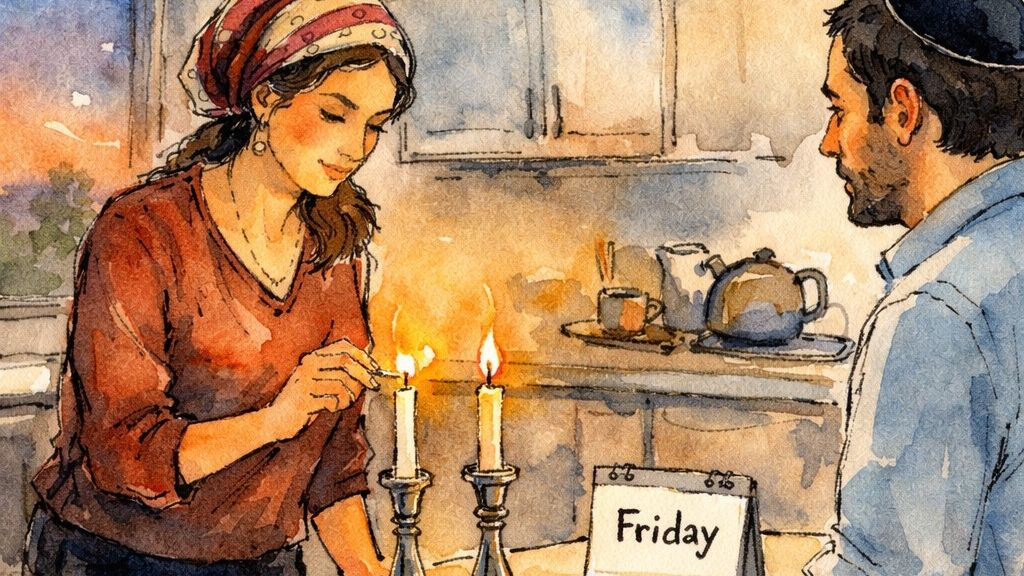
Pick one thing this week. Maybe it is the Shema every morning. Maybe it is lighting Shabbat candles on Friday night. Maybe it is reading the weekly parshah. Add a second thing only when the first feels like it belongs to you. This is the path the tradition itself prescribes: kabbalat ol malchut shamayim—accepting the yoke of heaven—one act at a time.
Where Denominations Diverge
Reform and Reconstructionist communities often emphasize choice and informed selection of mitzvot (Reform’s “informed choice” pedagogy goes back to the 1937 Columbus Platform). Conservative Judaism, while affirming Halacha as binding, has a strong tradition (mara d’atra) of the local rabbi adjusting expectations to the learner’s circumstance. Orthodox communities will encourage the full taryag as the eventual goal (taryag is the numeric acronym for the Torah’s 613 mitzvot — but rest easy, with no Temple standing, only 270 of those apply today to every Jew), though every Orthodox rabbi worth his smicha will affirm the principle of incremental, sincere growth.
Sources
What Is a Baal Teshuvah? — Chabad.org.
How Many of the Torah's Commandments Still Apply? — Chabad.org.
Makkot 23b (William Davidson Talmud) — Sefaria.
Berakhot 25.b (Steinsaltz Talmud portal) — The Steinsaltz Center.
Talmud Bavli, Berachot 25b—“lo nitna Torah l’malachei hasharet.”
Talmud Bavli, Avodah Zarah 3a—“ein hakadosh baruch hu ba bitrunia.”
Rabbi Moshe Feinstein, Igrot Moshe, multiple responsa on incremental observance.
Further Reading
Joseph Telushkin, Jewish Literacy—for the broad map.
Hayim Halevy Donin, To Be a Jew—for the practical first steps.
Anita Diamant, Choosing a Jewish Life—written for converts but equally useful for ba’alei teshuva.