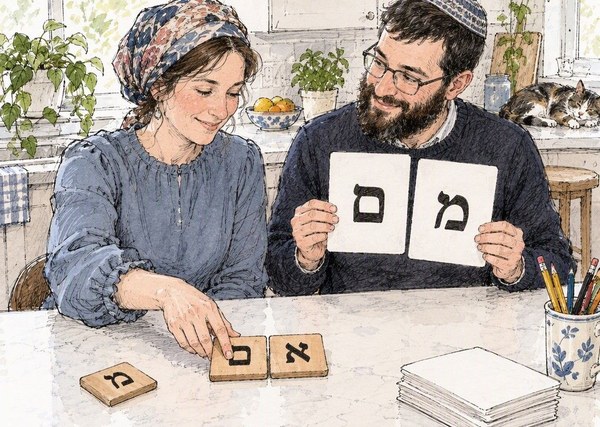
The Aleph-Bet
Twenty-two letters; five with final forms; read right to left. The first essential step.
The Aleph-Bet, Vowels, Reading, and Cantillation
Hebrew is the language of Tanakh, of the siddur, of three thousand years of Jewish thought, and (since 1948) of the modern State of Israel. Some Hebrew is a necessity. More than some, a deep enrichment.
Continue reading →Twenty-two letters; five with final forms; read right to left. The first essential step.
The diacritical marks below, inside, and above the consonants that indicate vowel sounds—present in the siddur and Chumash but not in the Torah scroll itself.
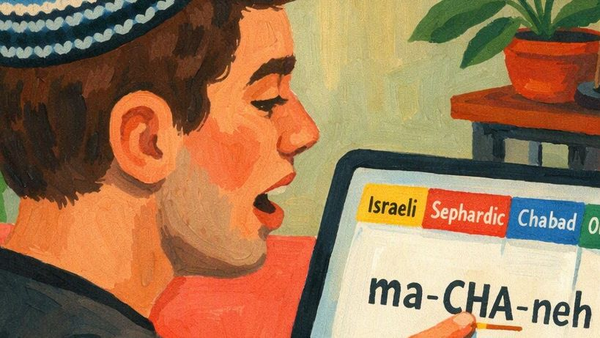
Four columns sit alongside the Hebrew. Three of them represent how real communities pronounce the prayers. One represents the letters themselves. Pick the one that matches the room you daven in, or the one that matches what you’re trying to learn.
A concrete weekly plan that takes an adult New Jew from zero to siddur fluency in a year.
Learn every letter and the sounds it makes — as a chart, then as a timed flashcard drill.
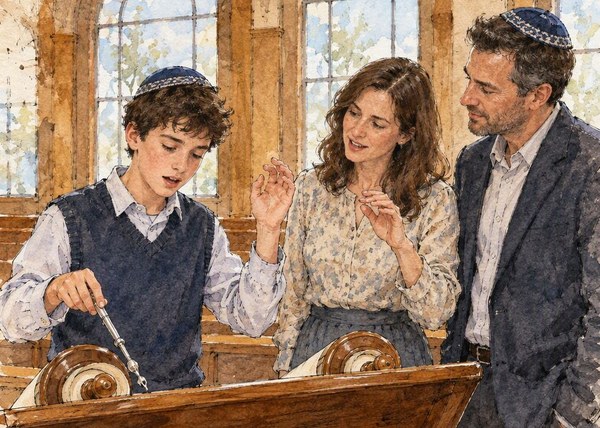
The musical notation used to chant biblical texts, preserving melody, phrasing, and interpretation.
The nikud — the points and dashes that voice the letters. Learn them as a chart, then drill them against the clock.
Grace is a translation, with a Greek history. It does not exist in the Torah in its Christian conception. But "Jews don't believe in grace," is absolutely false. So in answering the question, "Where is grace in the Torah," we need a better answer than simply, "It doesn't."
The most common words of the Torah, drilled in frequency groups of twenty-five — sounds or meanings, against the clock.