Summary
The New Jew gathers articles and learning tools for adults coming to Jewish faith and practice after childhood. Topic categories guide exploration of belief, texts, prayer, Hebrew, community, and Jewish living; levels distinguish first steps, core literacy, practical guidance, deeper study, and scholarly work. Begin with a manageable routine and return to the guide as questions arise.
What is The New Jew?
The New Jew is a field guide of sorts. For Jews who find faith and come into practice later in life, walking into your first shul service can be daunting. And while many resources exist for teaching children the basics of Torah, the Siddur, and Hebrew, those resources are fewer and far between for adults. They do exist, but not in one place, or as one cohesive and comprehensive program of learning.
The New Jew, we hope, will serve as both an index and a summary of these many resources, while also providing learning tools to fill gaps where they exist.
What is Judaism?
One of the central beauties of Judaism is that this question has a nuanced answer. Judaism is a religion. But Jews are a people—a people defined by culture and heritage, by genetic markers, or by adherence to Judaism. Jews are the oldest surviving ethnoculture in the world with an unbroken line of oral and written history, law, and tradition. As a people, and as a faith, we are nearly 3,500 years old.
And as a people, and as a faith, we are old enough to have matured—by wisdom and by exigency—into an understanding and tolerance of differing interpretations, understandings, and levels of practice of the Law. Over half of Jews worldwide are secular, with many of those having been among the fiercest defenders of our people in modern history, while formally practicing few to none of the Mitzvot (holy acts, or commandments) of the Torah. Others observe on a spectrum of practice from Ultra-Orthodox to Reform. While still others don’t fall squarely onto so easily-defined a scale, but rather, live according to reinterpretations of the Law.
What is a New Jew?
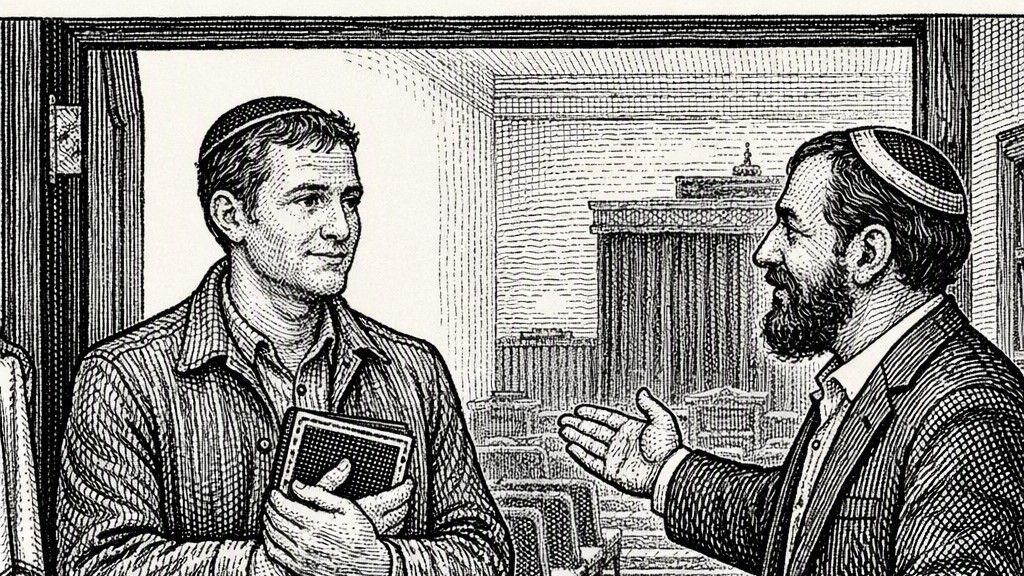
We, here, are New Jews. We aren't a different sort of Jew. It only means that we are Jews who have found faith and practice after the age of Bar/Bat Mitzvah, and so we’re learning without the benefit of childhood cultural inculcation.
Judaism is an active, hands-on, scholarly culture and religion. Christians are doing pretty well if they can answer “yes” to the question, “Have you read the Bible?” For Jews, the Torah (the first five books of the Old Testament) and the Tanakh (the whole of the Old Testament) are certainly the foundation, but they are only one layer of the foundation, with the Talmud and Midrash being two additional and essential layers, and the Siddur (usually in Hebrew) being central to daily, weekly, and festival observance. And that is not even to mention Machshava, Mussar, other commentaries and Halachic literature, and if you choose to venture into it, Kabbalah with the Zohar and Etz Chaim.
Jews have a different language, a different alphabet, a different calendar, the original Sabbath, and a host of beautiful and meaningful prayers and observances, cultural norms, and taboos.
There is a lot to know!
But it does not have to be daunting. It can and should be the joyful, gradual process of a lifetime. Every process needs a start, and a plan, and the tools and resources to carry that plan forward.
As Editor of The New Jew, I have only these qualifications: I have been through this process myself and spent years finding the best books, learning tools, resources, mentors, and communities to make this transition possible for myself; I am insatiably curious; and I have been blessed by God to have studied with rabbis who are far more learned than I shall ever be.
How to Use This Field Guide
Browse by subject and choose the depth that suits you. Orientation introduces first steps; Essential builds core literacy; Practice walks through what to do; Deeper explores concepts and disagreement; Scholarly offers extended source-based studies.
Finding Your Way
Getting Started: a calm path into a first synagogue visit, a first siddur, Shabbat, and the holiday year.
Foundations of Belief: Jewish identity, God, ethics, and the soul.
Torah & Texts: Tanakh, Talmud, mitzvot, commentary, and cycles of study.
Hebrew: letters, vowels, transliteration, cantillation, and a plan for learning.
Tools & Resources: siddurim, prayers, drills, reading lists, websites, and reference material.
Prayer & Liturgy: the daily services, central prayers, and guides to following them.
Community: finding a shul, a rabbi, and companions for learning and Jewish life.
Calendar: how Hebrew months, leap years, and recurring dates fit together.
Holidays: the festivals, fasts, and seasonal practices of the Jewish year.
Jewish Living: Shabbat at home, kashrut, ritual objects, and everyday observance. Editorial gathers personal essays and dialogues.
The Article Format
Article pages provide an opening lede, a summary, the main discussion, and sources or further reading where appropriate. Topic categories and depth levels help you choose a starting point.
Categories and levels: subject and depth are separate, so practical guides and deeper studies can share a topic.
Lede: a short opening that introduces the article.
Summary—a one-paragraph distillation of the article.
Body: the article’s main explanation or argument.
Where Denominations Diverge—a note on how Conservative, Reform, Reconstructionist, Renewal, and Traditionalist Egalitarian Jews may understand or practice differently.
Sources—the Tanakh verses, Talmudic tractates, classical commentators, and modern works cited in the article.
Further Reading—a short list of where to go next.
Editorial Stance
The guide is intended as a cross-denominational resource. It is written from an Orthodox starting point. This means: the Torah is treated as divinely given, Halacha as binding, the Shulchan Aruch as the canonical code, and the Talmud as the indispensable companion to the Tanakh. But the Jewish people are bigger than any single denomination, and every New Jew is well-served by knowing and considering how Conservative, Reform, Reconstructionist, Renewal, and Traditionalist Egalitarian thinkers and communities handle the same questions. Every article that has meaningful denominational variance will try to note it.
Transliteration
Hebrew is an ancient language, and over the last two thousand years in the diaspora, has pooled into pronunciation standards as diverse, at least, as English has (think California vs. Ireland).
The digital siddur offers Israeli, Sephardic, Chabad, and Orthographic transliteration columns. How to Read the Transliterations explains their pronunciation and stress marks. When a single transliteration is offered in article prose, it generally follows familiar Sephardic-Israeli usage: “Shabbat” rather than “Shabbos,” and “mitzvot” rather than “mitzvos.” Other community pronunciations are noted where relevant. The four-letter divine name is conventionally read as Hashem in prose and Adonai in prayer; the reader’s Sacred Names setting can display reverential substitutes.
Citation Conventions
Tanakh verses are cited by book, chapter, and verse (e.g., Devarim 6:4). Talmud is cited by tractate and folio (e.g., Berachot 25b). Midrash is cited by collection and section (e.g., Bereshit Rabbah 98:2). Where a modern work is cited, the author and title are given in the article and full bibliographic information appears in the Books chapter.
A Note on the Voice of This Guide
The Editor of this guide is a New Jew himself, walking the same path he is describing. The voice is therefore the voice of a fellow learner—occasionally certain, frequently delighted, and always more interested in opening doors than in closing them. Where the Editor offers his own commentary, it is marked as such. Where the tradition has spoken, the tradition speaks.
Sources
No. 39: Mature Jewish Secularism—Shalom Hartman Institute.
Ashkenazi-Sefardi Pronunciation—Aish.
Sacred Texts—ReformJudaism.org.
Is "Jewish" a Race?—…or maybe a nation? Or just an ethnicity?—Chabad.org.