Your First Shabbat
Shabbat at home—candles, kiddush, challah, a meal—is the gateway to Jewish life. Start small.
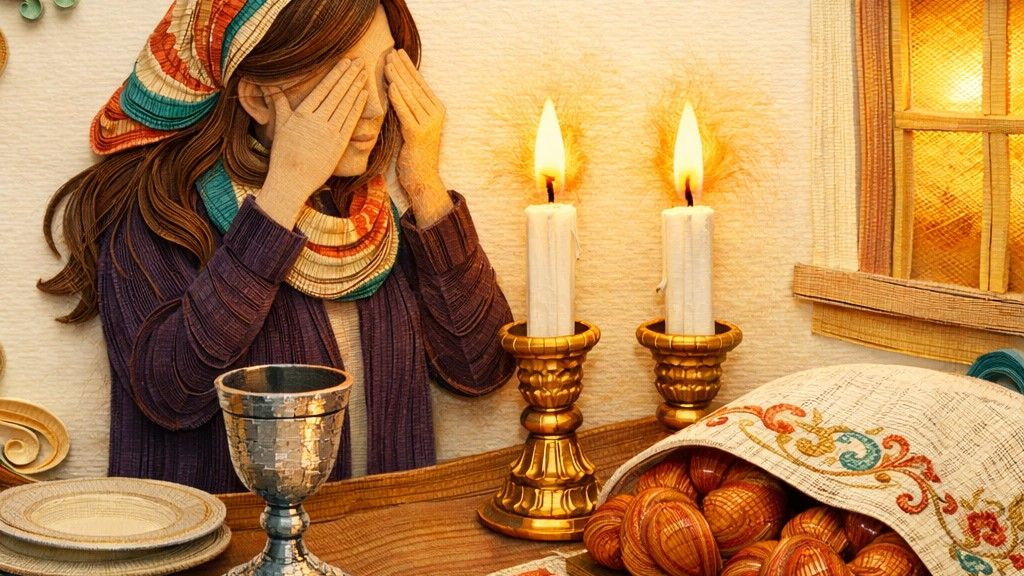
Summary. Shabbat begins at sunset on Friday—candles are lit eighteen minutes earlier, a customary margin added before the sacred time begins—and ends when three stars are visible Saturday night. The home rituals—lighting candles, kiddush over wine, the blessing over challah, a long unhurried meal—are independently observable and require nothing more than candles, a kiddush cup, and a loaf of bread. Each is sourced in the Torah and the Talmud and was already standard practice in the Mishnaic period. The simplest first Shabbat is also a real Shabbat.
Shabbat is the original Sabbath and the most distinctive practice of Jewish life. The Torah commands it (Shemot 20:8–11, Devarim 5:12–15), the Talmud develops the thirty-nine categories of melacha (creative work) that are prohibited (Mishnah Shabbat 7:2), and the Halacha (codified in Shulchan Aruch Orach Chaim 242–365) governs its details. But the home practices that frame Shabbat are simple, ancient, and within reach on the first try.
The Candles
Eighteen minutes before sunset on Friday, light two candles (more in some traditions—one for each member of the family), cover the eyes, and recite: Baruch atah Adonai, Eloheinu Melech haolam, asher kid’shanu b’mitzvotav v’tzivanu l’hadlik ner shel Shabbat. (“Blessed are You, Hashem our God, Sovereign of the universe, who has sanctified us with His commandments and commanded us to kindle the Shabbat lights.”) The blessing is traditionally said by women but may be said by anyone. The candles must be lit before sundown; once Shabbat has begun, kindling fire is forbidden.
Kiddush
Kiddush is the sanctification over a cup of wine that opens the Friday-night meal. The text is in every siddur. Use a full cup (at least a revi’it, roughly 3.3 fluid ounces) of kosher wine or grape juice. The Talmud (Pesachim 106a) derives kiddush from the Torah’s injunction to “remember the day of Shabbat to sanctify it” (Shemot 20:8).
Challah
Two loaves of challah on the table commemorate the double portion of manna in the wilderness (Shemot 16:22–26). Cover them with a cloth, recite the standard blessing over bread (hamotzi lechem min haaretz), and break them. Salt the bread before eating, in remembrance of the salt covenant of the altar (Vayikra 2:13).
The Meal
Eat slowly. Sing. The traditional Shabbat zemirot (table songs) are in the back of most siddurim, but conversation, laughter, and presence are themselves the mitzvah. Conclude with Birkat Hamazon, the grace after meals—the Koren Shalem Birkon is a beautiful pocket edition.
Where Denominations Diverge
Orthodox Halacha forbids all 39 categories of melacha, including electricity, driving, writing, and carrying outside an eruv. Conservative Judaism formally affirms the prohibitions but a 1950 responsum permits driving to synagogue. Reform Judaism treats Shabbat observance as a matter of meaning and choice rather than legal obligation. The home rituals—candles, kiddush, challah, meal—are universal across all denominations.
Sources
Torah: Shemot 20:8–11; Devarim 5:12–15; Shemot 16:22–26; Vayikra 2:13.
Mishnah Shabbat 7:2—the 39 melachot.
Talmud Bavli, Pesachim 106a—kiddush.
Shulchan Aruch, Orach Chaim 242–365.
Shabbat Starting and Ending Times — Peninei Halakha.
Why Are Shabbat Candles Lit 18 Minutes Before Sunset? — Chabad.org.
Kiddush and the Friday Night Meal — Chabad.org.
Shabbat Home Ritual — ReformJudaism.org.
Further Reading
Abraham Joshua Heschel, The Sabbath—the indispensable meditation.
Hayim Halevy Donin, Shabbat: A Guide to Its Understanding and Observance.
Blu Greenberg, How to Run a Traditional Jewish Household.
- Kashrut: The BasicsEssential
- KippahEssential
- Tallit and TzitzitEssential